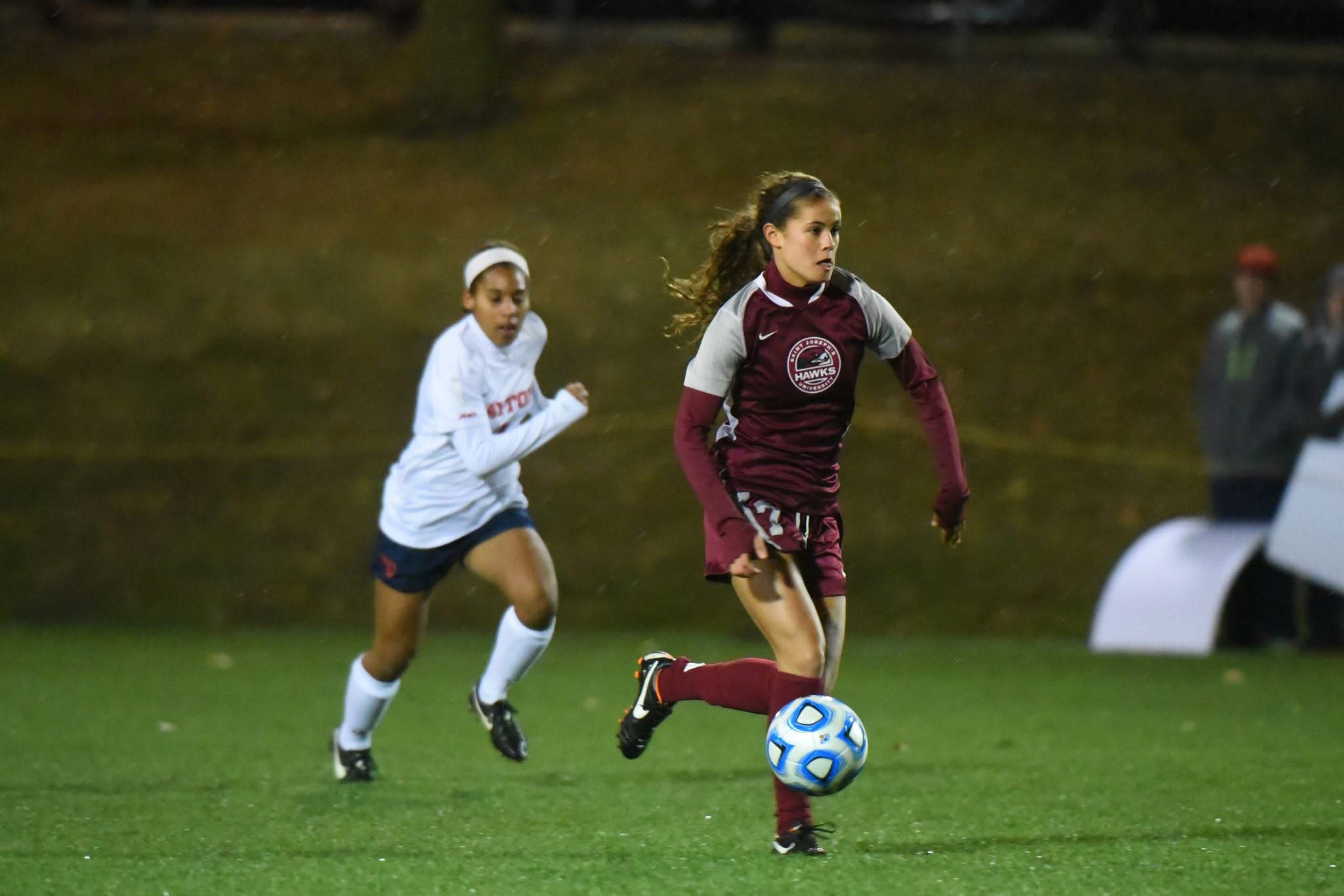
Growing up, I chose soccer early on, although it might be more accurate to say my parents realized dance wasn’t for me. Once I committed to the sport, I committed fully. My dad made sure I had every resource he could provide: training sessions, tournaments, and long drives to practice nearly every day. He believed that if I was going to do something, I should do it to the best of my ability. That mindset shaped far more than my athletic career. It shaped how I approach business today.
Long before I ever stepped into finance, I learned lessons on discipline, resilience, and performance that no classroom could fully teach.
My Edge Was Never Talent or Size—It Was Work I Did When No One Was Watching.
My dad would be the first to admit that my brother was more naturally gifted, but the difference was that I wanted it.
After scheduled practices and team training sessions, I would go home and head straight into my backyard to keep working. I set up cones for drills, ran fitness circuits, watched training videos, and spent hours refining fundamentals. Offseasons were not breaks. They were opportunities to gain an edge. Track workouts, conditioning routines, strength training, and whatever else I could control became part of my daily routine.
That same discipline carries me through long days and difficult stretches in my professional life. For example, if your weekly goal is 125 cold calls, completing 25 each day keeps you comfortably on track. But if you miss a day or two—because of travel, meetings, or any other distraction—it becomes incredibly difficult to make up 50 or 75 calls in a single day on top of an already full schedule. When motivation dips, as it inevitably does, discipline is what ensures consistency. Success, in both athletics and business, belongs to those who show up when no one is watching.
Reset. Refocus. Run again.
At Saint Joseph’s University, where I played Division I Soccer, Mondays were infamous. “Mile Monday” meant lining up at 7 a.m. in summer heat, freezing winter weather, or pouring rain to run a timed mile. The rule was simple: beat your previous weeks’ time.
I started the summer with a six‑minute mile. If I did not improve each week heading into winter, the consequences were immediate—extra sprints before practice and lifting to follow. There were no excuses, only accountability. At the time, I felt it was unfair that some teammates put in less effort since they had easier benchmarks to reach. Looking back, I realize it helped me earn a starting position all four years and extend my playing time on the field.
Today, when a deal falls apart or a cold call end in rejection, the lesson is the same. You assess what happened, learn from it, and move forward. You do not dwell. You reset and take the next opportunity with a better approach.
Quiet Leadership Speaks the Loudest.
I have never been the tallest or loudest person in the room. I have always tried to lead by example.
In athletics, consistency earns trust. Showing up every day, putting in the work, and staying composed under pressure builds credibility with teammates and coaches alike. Over time, that consistency creates influence.
In business, the same principle applies. Whether working with colleagues, partners, or founders, trust is built through reliability. Leadership is not about volume. It is about follow-through. People notice who delivers, especially when things get difficult.
Over 14,000 Calls Later, the Lesson Is Simple: Stay Consistent, Stay Competitive.
Partner outreach is not easy. Since starting at WPCG on January 1, 2021, I have made more than 14,000 cold calls. That experience has reinforced the value of patience, resilience, and repetition.
Athletics taught me that performance is often a numbers game. You do not win every play, every race, or every match, but effort compounds. In sourcing, differentiation matters. You are competing not only with private equity firms and aggregators, but also with wholesalers, vendors, and anyone else vying for the same advisor’s time and attention.
Staying competitive means staying consistent and being prepared when opportunity finally knocks on the door.
“To whom much is given, much is expected” (Luke 12:48)
During my time at Saint Joseph’s, I earned Magna Cum Laude and completed coursework towards my master’s degree during my senior year, all while competing in season for Division I soccer. I was fortunate to earn both academic and athletic scholarships for my undergraduate and graduate degrees, but with that opportunity came pressure. Time management and prioritizing demands were learned skills.
Balancing rigorous academics with the physical and mental demands of high-level athletics forced me to master time management early. That foundation has carried me through full days five days a week in the office in Manhattan, along with long travel days, and unforeseen challenges that have come my way.
Pressure does not disappear, but your ability to manage it improves with repetition. I feel incredibly blessed for the opportunities I was given to compete in soccer at the highest level, and today I feel even more blessed for the opportunity to work every day at Wealth Partners Capital Group.
On a personal front, my husband sometimes says that my family holds me to higher standards than my siblings. I always tell him that I don’t compare myself to others. I’ve been given so much—by the grace of God—that I feel I have even more to give. My husband, as both my partner and teammate, also recognizes the many blessings we’ve received and strives to meet the higher standards expected of us as a couple.
“That which is surrendered is taken care of best.”
One of the most valuable lessons athletics teaches is acceptance. There will always be variables outside your control—whether it’s a coach’s decision, an injury, or circumstances beyond preparation. If you have given it your all, the next step is to give it to God.
As Marianne Williamson writes in A Return to Love: “The truth is, of course, that the more important it is to us, the more important it is to surrender. That which is surrendered is taken care of best. To place something in the hands of God is to give it over, mentally, to the protection and care of the beneficence of the universe (p. 58).”
In business, those variables take the form of market downturns, interest rate shifts, or global disruptions like COVID. The lesson remains unchanged. Control what you can. Prepare relentlessly. Go the extra mile before the opportunity arrives so that when it does, you are ready.
Trust in the process is not passive. It is earned through preparation.
Final Reflection
I am grateful for the countless lessons athletics gave me. I am grateful to my dad for pushing me to reach my potential. I am grateful to myself for staying committed and seeing it through at the highest level I could reach. I am grateful for the relationships forged through sport and for the discipline built through early mornings, physical exhaustion, and mental stress.
That discipline now shows up in my career, in the resilience required to navigate uncertainty, the consistency needed to build trust, and the confidence to keep going when outcomes are not immediate.
Division I athletics did not just prepare me for business.
It prepared me for everything business does not warn you about.